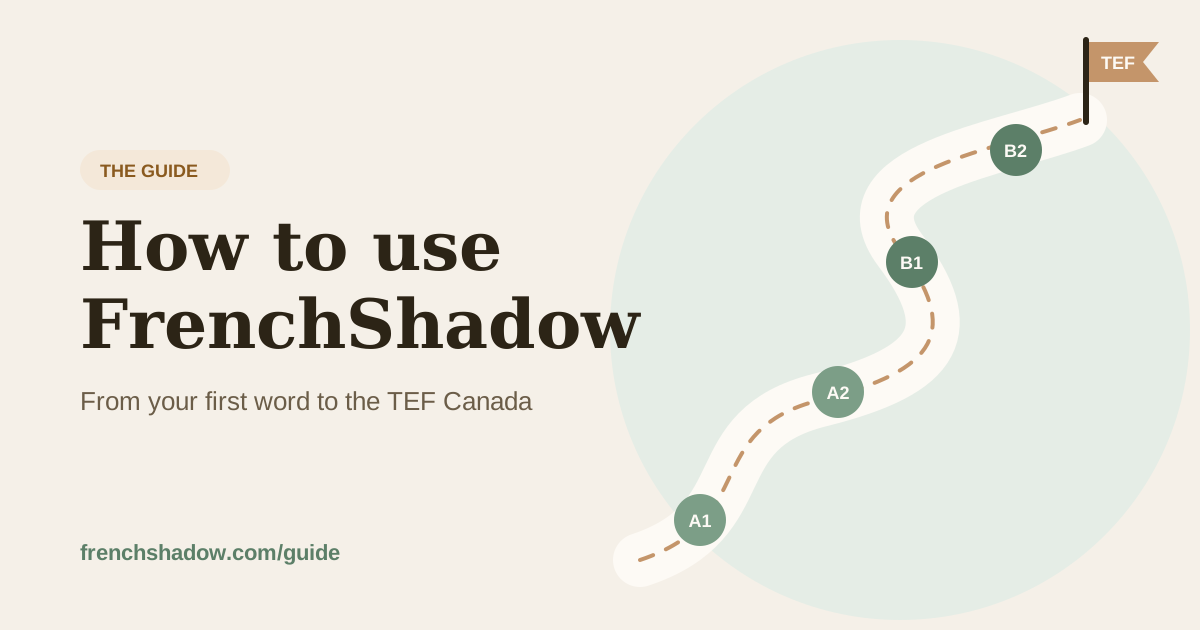
FrenchShadow takes you from your first French word to the TEF Canada exam, with a score after every answer. Beginners follow Your path one unit a day. TEF candidates train each ability on the real exam format, follow the topics candidates are reporting this month, then sit timed mock exams. This guide shows you the route.
Pick your path
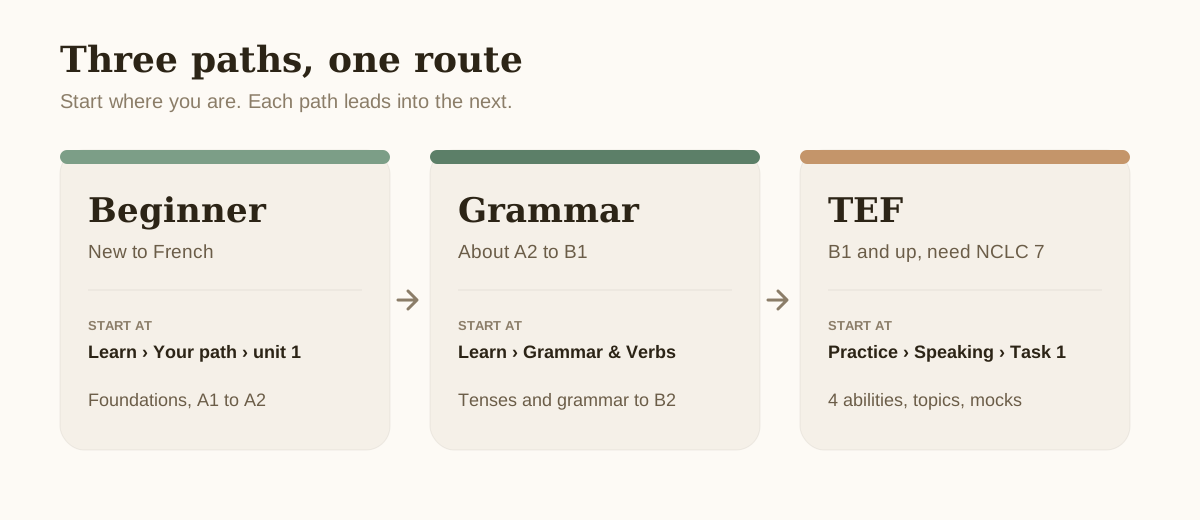
| Path | If you… | Start at | First week |
|---|---|---|---|
| Beginner | Are new to French, or know a few words | Learn › Your path › unit 1 | One unit a day, 10 to 15 minutes |
| Grammar | Can talk about your day, but grammar slips (A2–B1) | Learn › Your path › Grammar & Verbs | One tense unit a day plus one speaking session |
| TEF | Speak French and need NCLC 7 for Express Entry | Practice › Speaking › Task 1 | All four abilities, the reported topics, then mocks |
Not sure? Do one free speaking session (Practice › Speaking › Task 1). NCLC 4 or lower: start with the Grammar path. NCLC 5 or higher: follow the TEF path.
Five tabs: Home for today's plan, Learn for your path, Practice for the four abilities, Exam for topics and mocks, and Me for your progress and plan. Léa, the AI teacher, is on every page except tests.
Getting started: your first 15 minutes
You need an email address and a microphone. No card is needed to start.
- Try it first (optional). On frenchshadow.com/try, answer one speaking question and get an estimated band without an account.
- Create your account with email or Google. Starting from zero? The “Start from zero” button on the home page opens your path at unit 1.
- Set your exam date and target in Me › Plan & settings. No exam booked? Pick a date about 3 months out and change it later.
- Allow the microphone when the browser asks. Use Chrome or Safari in a quiet room; a headset helps.
- Do your first session. Beginners: Learn › Your path › unit 1. TEF candidates: Practice › Speaking › Task 1.
- Read your score report: an estimated NCLC band and the one mistake to fix first, with a link to the lesson that fixes it.
- Come back tomorrow. Home shows “Today's free practice”: what is still free today, per ability.
On your phone, FrenchShadow runs in the browser. On iPhone tap Share › Add to Home Screen; on Android tap the menu › Add to Home screen.
Beginner path: from zero to the exam
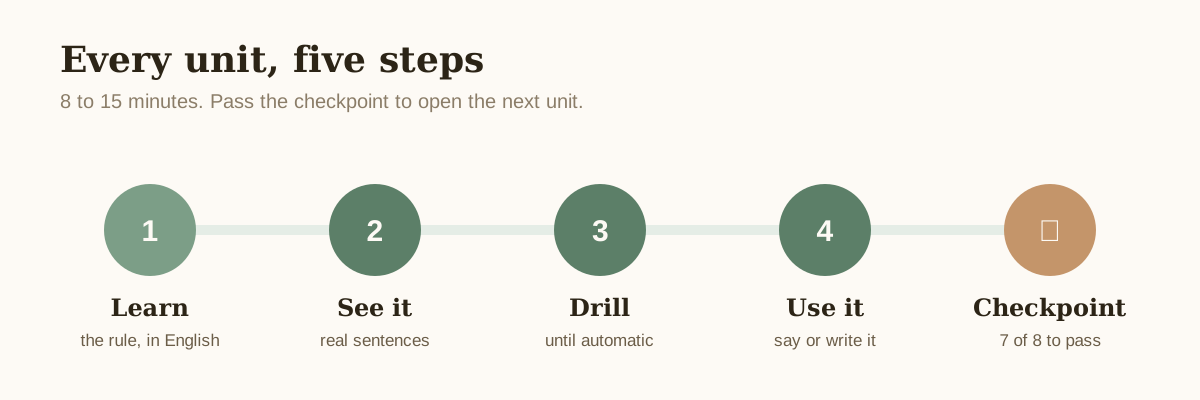
Three stages in one route: Foundations (zero to A2, 18 units), Grammar & Verbs (A2 to B2, 21 units), then Exam training. Find it in Learn › Your path. Each unit takes 8 to 15 minutes and has the same five steps.
| # | Foundations unit | Level |
|---|---|---|
| 1 | Sounds and spelling | A1 |
| 2 | Greetings and politeness (tu or vous) | A1 |
| 3 | Je suis: être, introducing yourself | A1 |
| 4 | J'ai: avoir, age, numbers 0 to 20 | A1 |
| 5 | Nouns and articles | A1 |
| 6 | Describing: adjectives and agreement | A1 |
| 7 | -ER verbs in the present | A1 |
| 8 | Asking questions | A1 |
| 9 | Saying no | A1 |
| 10 | Numbers, time, dates, prices | A1 |
| 11 | Family and "my" | A1 |
| 12 | Going places: aller, "je vais + verb" | A1 |
| 13 | My day: reflexive verbs, -IR and -RE verbs | A2 |
| 14 | Food and shopping: "je voudrais" | A2 |
| 15 | The four helper verbs: faire, vouloir, pouvoir, devoir | A2 |
| 16 | Home, city, directions | A2 |
| 17 | First step into the past: passé composé | A2 |
| 18 | Your first conversation: a phone call, like TEF Section A | A2 |
Grammar & Verbs has 13 tense units (présent, passé composé, imparfait, futur, conditionnel, si clauses, subjonctif, plus-que-parfait and more) and 8 grammar units at B1–B2: articles, object pronouns, relative pronouns, negation, comparing, prepositions, agreement and linking words. When you finish, switch to the TEF path below.
A beginner's day, 20 to 30 minutes:
- Vocabulary review: the words due today (5 minutes).
- One path unit, all five steps (10 to 15 minutes).
- One general speaking session, such as a café or doctor role play (5 to 10 minutes).
About one unit a day gets you through Foundations in 3 to 4 weeks and Grammar & Verbs in about 2 more months.
TEF Canada path: section by section
Most Express Entry candidates aim for NCLC 7 in all four abilities. Train each ability on the real format, follow the reported topics, then sit full mock exams.
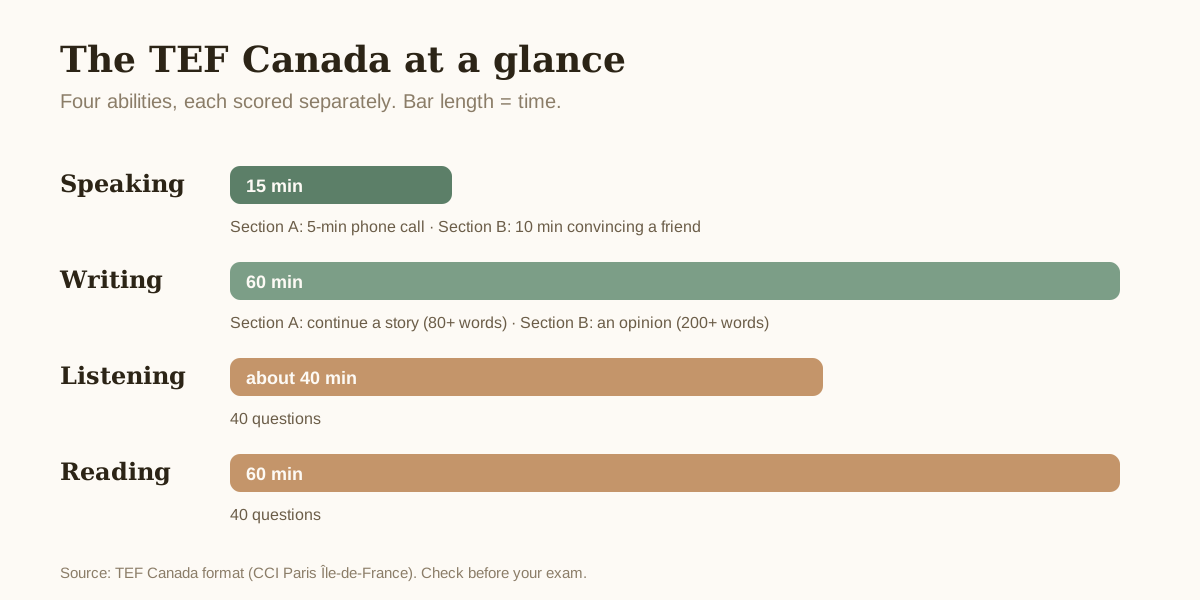
Each ability has its own place in the app: Practice › Speaking (Task 1 and Task 2), Practice › Writing, Practice › Listening and Practice › Reading. Check the format on the official TEF Canada page before your exam.
- Find your level (day 1). One Speaking Task 1 and Task 2, one reading and one listening set, one Writing Section A. Your weakest ability gets the most time; Me › Progress shows all your bands.
- Learn the strategy (week 1). Learn › Exam strategy lessons: formal register, asking 10 or more questions in Section A, three arguments in Section B, handling objections.
- Practise each ability. In speaking, the AI examiner plays the person on the phone (Task 1) or a friend who objects (Task 2), and you get a band, scores on the official criteria and the one mistake to fix. Practice › Topics breaks every topic into parts with model answers. Writing gives a graded report with corrected sentences, and Study mode shows model answers. Reading and listening are marked instantly with explanations; listening plays at exam speed.
- Follow the real exam topics. Exam › Reported exam topics shows what candidates got this month. Practise the top 10, and let Exam › Study plan tick them off. See the speaking topics and writing topics lists.
- Mock exams (last 3 to 4 weeks). Speaking mock (both tasks, timed), writing mock (60 minutes) and reading mock (40 questions, 60 minutes). One full mock a week, two in the last week.
- After your exam, record your result and topics in Exam › My exam result. It takes 2 minutes and keeps the topic list accurate for the next candidates.
Not sure what your scores mean? Use the TEF score chart and the NCLC to CRS converter.
What each plan includes
Free gives you some of everything each day. Oral unlocks speaking and listening; Max unlocks all four abilities.
| Feature | Free | Oral | Max |
|---|---|---|---|
| Your path | First units in full; Learn and See it in every unit | All units and steps | All units and steps |
| Strategy lessons, vocabulary review | Yes | Yes | Yes |
| TEF speaking | 1 scored session a day | Up to 20 a day | Up to 20 a day |
| General speaking | 2 a day | Up to 15 a day | Up to 15 a day |
| Speaking topics | All (sign in) | All | All |
| Writing | 2 sample topics, 1 a day | 2 sample topics, 1 a day | All topics, up to 20 a day |
| Listening | 10 new questions a day | All | All |
| Reading | 10 new questions a day | 10 new questions a day | All |
| Reported topics, study plan | Yes | Yes | Yes |
| Mock exams | Speaking (counts as a session) | Speaking | Speaking, writing, reading |
| Léa, AI teacher | 10 messages a day | Unlimited | Unlimited |
Free limits reset at midnight UTC. Free without an account: the NCLC to CRS converter, the TEF score chart, the practice test and TEF vs TCF.
Study plans: 30, 60 or 90 days
Each plan assumes 45 to 60 minutes a day, 6 days a week. Already at NCLC 6 or higher everywhere? 30 days is enough. Starting from zero? Do the beginner path first (about 3 months), then the 90-day plan.
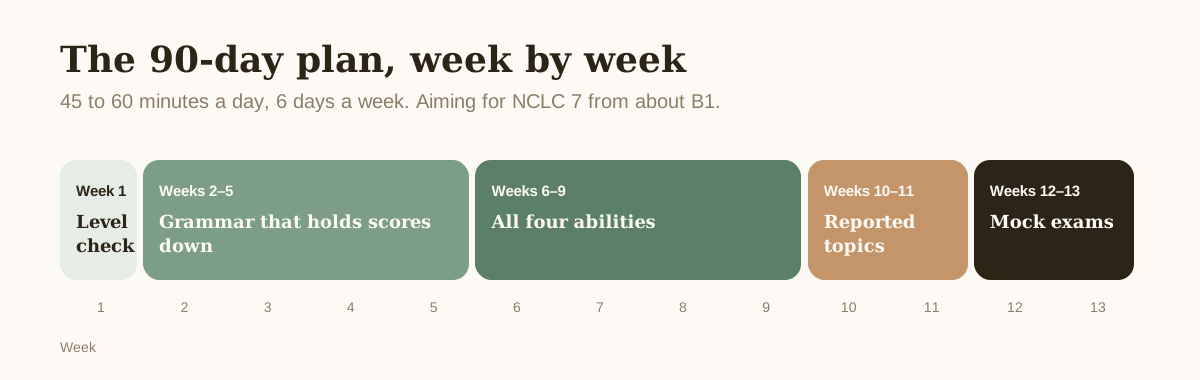
| 90 days | Focus | Each day |
|---|---|---|
| Week 1 | Find your level, strategy | Day 1 tests in all four abilities; one strategy lesson a day |
| Weeks 2–5 | Grammar that holds scores down | One Grammar & Verbs unit, one speaking session, vocabulary review |
| Weeks 6–9 | All four abilities | Alternate Task 1 / Task 2; one writing task; 10 reading or listening questions |
| Weeks 10–11 | Reported exam topics | Top 10 reported topics, part by part, in speaking and writing |
| Weeks 12–13 | Mock exams | One full mock a week, fix the weakest ability; two mocks in the last week |
| 60 days | Focus | Each day |
|---|---|---|
| Week 1 | Find your level, strategy | Day 1 tests; one strategy lesson a day |
| Weeks 2–4 | Weakest ability first | Two sessions in your weakest ability, one in another; a tense unit every 2 days |
| Weeks 5–6 | Reported exam topics | Top 10 topics in speaking and writing |
| Weeks 7–8 | Mock exams | One mock a week, two in the last week |
| 30 days | Focus | Each day |
|---|---|---|
| Week 1 | Strategy and level check | Strategy lessons; one session per ability |
| Week 2 | Reported topics | Two speaking sessions on top topics; one writing task |
| Week 3 | First mocks | One full mock; fix the one mistake each report flags |
| Week 4 | Final week | Two mocks, light review, rest the day before |
Rules for every plan: do the vocabulary review daily, fix the mistake the report names before the next session, speak out loud, and review only in the last 2 days.
Plans and billing
| Plan | Covers | Price (CAD) | Best for |
|---|---|---|---|
| Free | Some of every ability each day | $0, no card | Trying it; beginners on the first units |
| Oral | Speaking and listening, plus the full path | From $19.99 a month | Candidates whose weak point is speaking |
| Max | All four abilities and all mock exams | From $25 a month | Candidates who need NCLC 7 everywhere |
| Exam Pass | Oral or Max for 90 days, one payment, no renewal | Oral $39.99 · Max $50 | An exam booked within 3 months |
Today's prices are always on the pricing page.