The TEF Canada is a French test recognised by Immigration, Refugees and Citizenship Canada (IRCC). For immigration you take four tests: reading, listening, writing and speaking. There's also a citizenship version with just two: listening and speaking. Whichever one you sit, all your tests must be taken on the same day.
This guide covers the format, how fees and booking work, what makes the exam hard, and how to prepare. Still deciding between the two French tests? Start with TEF vs TCF.
What is the TEF Canada exam and who needs it
TEF stands for Test d'évaluation de français. The Canadian version is run by Le français des affaires, part of the CCI Paris Île-de-France, and IRCC has recognised it since 2002.
People usually take it for one of two reasons:
- Immigration. You sit all four tests. We cover the French side of Express Entry in French for Express Entry.
- Citizenship. Le français des affaires offers a citizenship version with listening and speaking only. On IRCC's side, citizenship applicants aged 18 to 54 must prove they can speak and listen at CLB 4 or higher.
Two things you don't need: a diploma, or to be an adult. The minimum age is 16.
TEF Canada exam format and timing
Here is the immigration version, with the official timings.
| Test | Time | What you do | |---|---|---| | Reading (compréhension écrite) | 1 hour | 40 multiple-choice questions | | Listening (compréhension orale) | 40 minutes | 40 multiple-choice questions | | Writing (expression écrite) | 1 hour | 2 tasks: Section A (25 min) and Section B (35 min) | | Speaking (expression orale) | 15 minutes | 2 tasks: Section A (5 min) and Section B (10 min) |
The citizenship version uses the same listening and speaking tests.
Reading and listening
Both are multiple choice. A correct answer earns one point. A wrong or blank answer earns zero, so never leave a question empty.
Forty reading questions in an hour works out to about 90 seconds each. Listening is tighter: 40 questions in 40 minutes.
Writing
Writing has two tasks, and they ask for very different things.
Section A (25 minutes, at least 80 words): you continue an article. In our practice format, you get the opening of a news-style story and write what happens next.
Here's a practice-style opening (not a real exam item):
Depuis le mois dernier, les habitants du quartier peuvent emprunter gratuitement des outils à la bibliothèque municipale. (Since last month, residents of the neighbourhood can borrow tools for free from the public library.)
One way to continue it is to explain where the idea came from:
L'idée vient d'un groupe de voisins qui trouvaient dommage d'acheter une perceuse pour s'en servir une fois par an. (The idea came from a group of neighbours who thought it was a shame to buy a drill and use it once a year.)
Section B (35 minutes, at least 200 words): you express and justify a point of view. In our practice format, that means a statement like Le télétravail devrait devenir la norme (remote work should become the norm), and you take a side with reasons and examples.
Phrases that help you structure Section B:
- À mon avis,... (In my opinion,...)
- D'une part..., d'autre part... (On the one hand..., on the other hand...)
- Certes..., mais... (Admittedly..., but...)
- Prenons l'exemple de... (Take the example of...)
- En conclusion,... (In conclusion,...)
Speaking
Speaking lasts 15 minutes in two parts. Section A (5 minutes) is about obtaining information. Section B (10 minutes) is about arguing to convince.
Section A, in our practice format: you call about a short advert, use vous, and ask plenty of varied questions. One of our practice topics is home guitar lessons:
Bonjour, je vous appelle au sujet de votre annonce pour des cours de guitare à domicile. Pourriez-vous me dire si vous acceptez les débutants ? (Hello, I'm calling about your ad for guitar lessons at home. Could you tell me if you take beginners?)
Section B, in our practice format: you present something from an advert and try to convince a friend, who pushes back. Most of your time goes on answering objections:
Je comprends, mais justement, c'est l'occasion idéale d'essayer quelque chose de nouveau. (I get it, but that's exactly why it's the perfect chance to try something new.)
We go much deeper on both parts in the TEF Canada speaking test guide. For practice material, browse our TEF speaking topics by theme.
The same-day rule
The official rule: all tests must be taken on the same day for the certificate to be recognised by Canadian authorities. So no, you can't sit reading this month, speaking next month, and stitch the two together. One day. Everything.
Scores, NCLC levels and what you need
Your certificate gives three results for each test:
- a TEF score from 0 to 699
- a CEFR level from A1 to C2
- an NCLC level from 1 to 12
NCLC is the French name for the Canadian Language Benchmarks (CLB).
Writing is marked by two trained assessors. Speaking is assessed by two examiners.
What level do you need? It depends on the program. For citizenship, IRCC asks for CLB 4 in speaking and listening. For immigration programs, check the IRCC page for your program, and see how levels connect to points with our TEF to NCLC and CRS converter.
How long is it valid? The certificate is valid for two years from its date of issue. Plan your exam date around when IRCC will need it, not just around when you feel ready.
TEF Canada exam fees
There is no single official price. Each test centre sets its own fees, and the price can change with the number of tests you take.
That's why you'll see very different numbers online. A blog quoting one price is usually quoting one centre, sometimes from an old page.
Practice makes perfect
Train with real TEF speaking scenarios
Get instant AI feedback on your French speaking
Start free →How to find your real cost:
- List the official test centres near you.
- Open each centre's TEF Canada page and check the price for the version you need (four tests for immigration, two for citizenship).
- Look for extra costs: admin fees, membership rates, or a separate price for single tests.
- If you are exempt from some tests, you are billed only for the tests you actually take.
Budget beyond the exam itself. Travel, time off work and prep materials all add up. And because registration is firm and final (more on that below), the centre keeps the fee you paid if you miss the exam without a justified reason.
How to book the TEF Canada exam
The official network has about 500 test centres in more than 110 countries. You book with a centre, not through a central portal.
- Find an official centre near you.
- Pick a session and register directly with that centre.
- Pay the centre's fee.
- Check before the day. If you still don't have your exam details a week before, look in your spam folder. You can also contact the centre directly.
The official advice is to register as early as possible. In our experience, sessions at big-city centres can fill up fast, so if you have an IRCC deadline, book first and plan your study around the date.
Cancellations and missed exams
Read this before you pay. Registration is firm and final, and the centre keeps your fee. Treat the date as fixed the moment you book.
- If you cancel or miss the exam for a serious reason, such as illness, you must send proof, for example a medical certificate or an employer's letter.
- After reviewing your reasons, Le français des affaires may offer a new registration at no extra cost.
- An unjustified absence or withdrawal is not refunded.
Accessibility arrangements
If you need special arrangements, send a medical certificate to the test centre before you register. The doctor should explain the nature of the disability and recommend adjustments to the test. Centres can also help candidates who struggle with computers, for example with a paper writing test.
Retakes
The official pages we checked don't set out a retake policy. Ask your centre about its rules before you book a second attempt.
How hard is the TEF Canada exam?
The honest answer: it depends on the level you need and on which tests are your weak spots.
Aiming for CLB 4 in listening and speaking for citizenship is a very different job from aiming high in all four tests for Express Entry. Work out your target first. Then judge the difficulty against it.
From what we see with learners who prepare on their own, the productive tests are where most people struggle:
- Speaking is live. There's no pause button, and in our practice format the other person keeps pushing back in Section B.
- Writing needs speed. Section B asks for at least 200 words of argument in 35 minutes, and you'll want time to reread.
Reading tends to feel the most manageable because you control the pace. Still, 40 questions in 60 minutes doesn't leave much room if you reread every text twice. You'll feel it on the last few.
The quickest way to see where you stand is to try a real-format task against the clock. You can do a free speaking attempt on FrenchShadow and get an estimated NCLC-style score in a few minutes. It's an estimate, not an official result.
How long to prepare for the TEF Canada
Anyone who gives you a fixed number of months is guessing. It depends on where you start, how high you need to go, and how many hours you can actually put in each week.
Here's a rough planning guide. It's our own estimate for building exam skills, not an official figure and not a promise of any result.
| Where you are now | What to plan for | Main focus | |---|---|---| | You can hold a basic conversation but freeze on exam tasks | 4 to 8 weeks of steady practice, a few hours a week | Learn the task formats, practise against the clock | | You understand a lot but your speaking and writing lag behind | 2 to 4 months | Daily speaking, two timed writing tasks a week | | You are still building everyday French | Several months or more | General French first, exam tasks gradually |
Only have a month? Then spend it on the format and on timed practice, and be realistic about how far your level can move in that time.
A sample 8-week plan
- Weeks 1 to 2: learn the format. Do one task of each type untimed. Note where you get stuck.
- Weeks 3 to 4: build structure. Learn a simple plan for each writing section and each speaking section. Practise speaking out loud every day, even 10 minutes.
- Weeks 5 to 6: add the clock. Do every task timed. Write one Section A and one Section B each week.
- Week 7: full mock. Sit all four tests in one sitting, with the official timings, as on exam day.
- Week 8: fix and rest. Review your weakest test, then go lighter in the last few days.
TEF Canada preparation: what actually works
Listening
Listen to Canadian and French radio every day, and switch the subtitles off on what you watch. When you practise exam questions, read the question before the audio starts so you know what to listen for.
Reading
Practise with real texts: ads, notices, news articles, opinion pieces. Time yourself at about 90 seconds per question. If one is taking too long, make your best guess and move on.
Writing
Learn a plan for each section and use it every time. Our advice:
- Section A: stay in the style of the article, add details (who, where, when), and end with a consequence or what happens next.
- Section B: introduction with your position, two or three arguments with examples, an answer to the other side, a conclusion.
Keep five minutes at the end to check agreements and verb endings. They add up.
Speaking
Our advice here is simple. Speaking is physical, so say it out loud. Rehearsing answers silently in your head on the bus feels productive, but it trains a different thing from forming sentences with your mouth while someone waits for you to finish.
- In Section A, aim for around ten varied questions and follow up on the answers.
- In Section B, use one pattern for each objection: react, add a connector, give an argument, suggest something.
- Record yourself once a week and listen for long pauses and register slips (tu vs vous).
For material, see our 150 TEF Canada speaking topics and our notes on practising TEF speaking with AI.
Practise with feedback, not just repetition
Practising alone has one big weakness: you can't hear your own mistakes. Model answers show you what a good response sounds like. An estimated score shows you roughly where you are.
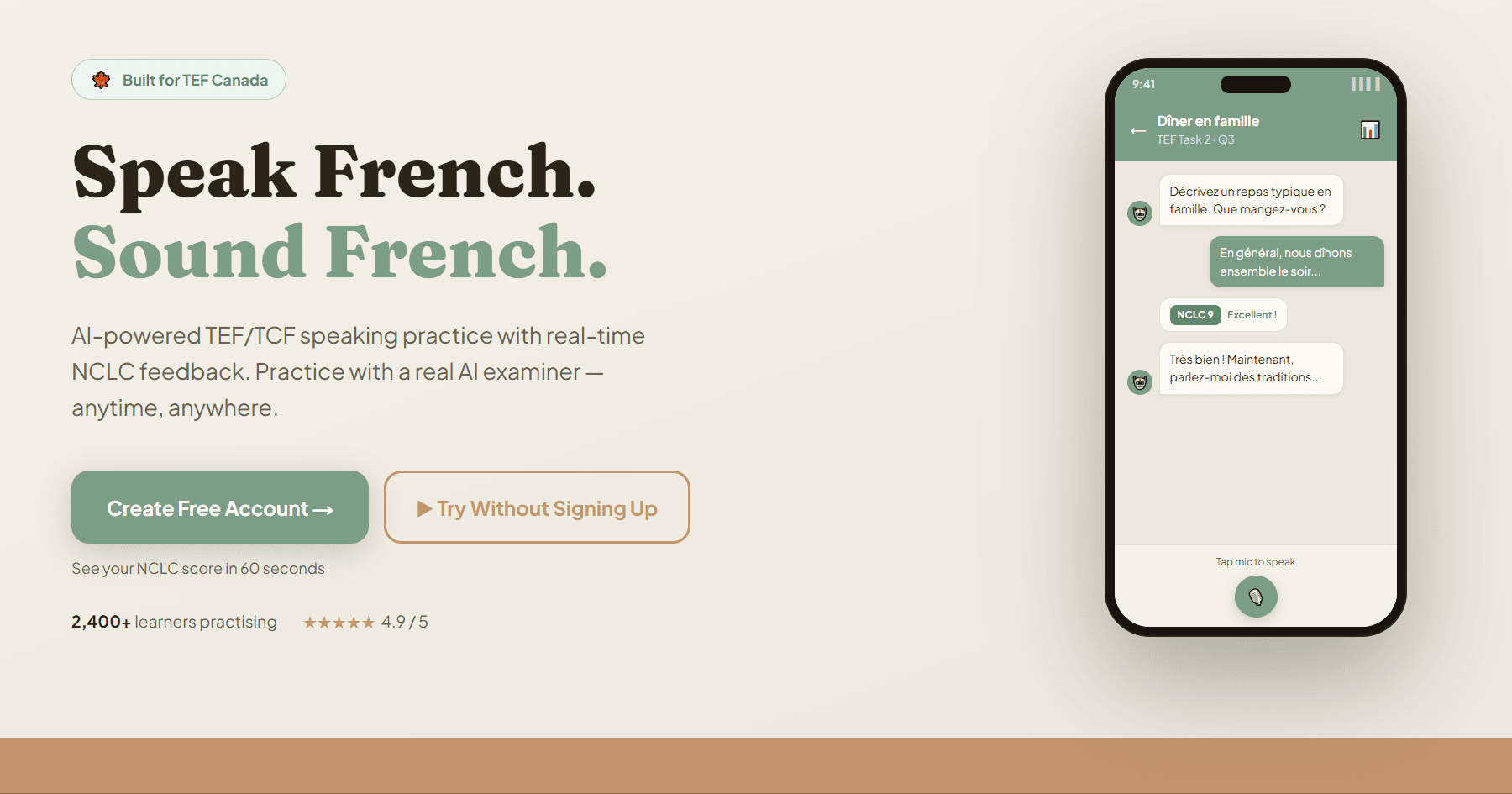
That's the gap FrenchShadow fills. You answer real-format speaking tasks out loud, an AI examiner plays the other side, and you get feedback with an estimated NCLC-style level. You can start free, and plans are there if you want more practice.
Test day checklist
- Reread everything your centre sent you: address, arrival time, and what ID to bring.
- Bring exactly the ID your centre asks for.
- Plan to arrive early.
- Remember the same-day rule: all your tests happen in one day, so eat well and bring water if allowed.
- If something goes wrong during a test, tell the supervisor on the day. You'll need that if you appeal later.
After the exam: results and next steps
Your certificate shows your TEF score, CEFR level and NCLC level for each test. It also has an "Old score equivalence" column.
When you fill in your IRCC online profile, use the scores in that Old score equivalence column, as the official results page instructs. The IRCC certificate number is the part of the attestation number before the hyphen (bottom left of the certificate). The part after the hyphen is your NIP.
If something went wrong on the day, you can appeal within 30 days of the certificate's date of issue. Appeals are only considered for an anomaly or serious malfunction during the test, not because you hoped for a higher score.
Try a real TEF task today
The fastest way to learn what the TEF Canada asks of you is to try a task. Pick a speaking topic, answer out loud against the clock, and see where you land. Start a free practice session on FrenchShadow, no signup needed.
Every scenario mentioned here is available to rehearse in the TEF Canada speaking topics library — browse Task 1 and Task 2 scenarios by theme and practise each one out loud with an AI examiner.