The TEF Canada speaking test (expression orale) lasts 15 minutes and has two parts. In Task 1 (Section A, 5 minutes) you ask questions to get information. In Task 2 (Section B, 10 minutes) you try to convince someone. Both are role plays with an examiner, and both are recorded.
Most candidates know the topics. What costs them NCLC levels is how they answer. This guide walks through each task, shows worked examples from real practice topics, and lists the mistakes to avoid.
If you want the topic list first, see 150 TEF Canada speaking topics or browse them by theme.
The two tasks at a glance
- Task 1 (Section A): 5 minutes. You read a short advert and call for more information. Formal register: use vous. The examiner plays the person who placed the advert.
- Task 2 (Section B): 10 minutes. You read an advert and try to convince a friend to take part. Informal register: use tu. The examiner plays the friend and pushes back.
- Both: scored on the NCLC scale. What matters is whether you communicate clearly, use the right register, and keep the conversation going.
Task 1: how to get the information you need
Task 1 tests one thing: can you gather information politely and precisely? You do most of the talking by asking questions, so the quality and variety of your questions is the whole game.
A simple structure for Task 1
- Open the call and say why you are calling.
- Ask about the essentials in a logical order: what it is, when, where, how much, who it is for, how to sign up.
- Follow up on the answers. This shows you are listening, not reading a list.
- Close the call politely.
Aim for around ten well-formed questions. Vary how you build them, because repeating Est-ce que… ten times sounds mechanical.
Useful question forms
- Pourriez-vous me dire… (Could you tell me…)
- J'aimerais savoir si… (I would like to know whether…)
- Est-ce qu'il faut… (Is it necessary to…)
- Quels sont les horaires ? (What are the times?)
- Combien coûte… (How much is…)
- Inversion for a formal tone: Proposez-vous des cours le week-end ?
Worked example: Cours de guitare à domicile
The advert offers guitar lessons at home, adapted to your level and taste. Here is how a strong opening and a few questions could sound:
Bonjour, je vous appelle au sujet de votre annonce pour des cours de guitare à domicile. Pourriez-vous me dire comment se déroule le premier cours ? J'aimerais savoir si vous acceptez les débutants complets. Quels sont vos tarifs, et proposez-vous des forfaits pour plusieurs cours ?
Practice makes perfect
Train with real TEF speaking scenarios
Get instant AI feedback on your French speaking
Start free →Then follow up on what the examiner says. If they mention a price, ask whether materials are included. If they mention flexible hours, ask whether evenings are possible. Practise this topic.
More Task 1 topics to practise
- Centre équestre « Cheval Club »: ask about levels, safety, equipment and booking.
- Arts martiaux: ask which sports are offered, trial classes and schedules.
- Aides aux devoirs: ask about group sizes, subjects and prices.
Task 2: how to convince someone
Task 2 is longer and harder. You present something from an advert and try to convince a friend to join you. The examiner raises objections, and your job is to answer each one and keep persuading.
A simple structure for Task 2
- Hook: start with enthusiasm and explain what you found.
- Pitch: give two or three concrete reasons it would be good for your friend, not just for you.
- Handle objections: react, acknowledge, then counter with a reason or a solution.
- Close: suggest a next step, like signing up together.
A pattern that works for each objection: react → connector → argument → proposal.
Je comprends, mais justement… / C'est vrai, cependant… / Je vois ce que tu veux dire, par contre…
Worked example: Atelier théâtre (On improvise)
The advert is for an improv theatre workshop. The friend says they are too shy. A strong reply:
Je comprends, mais justement, c'est l'endroit idéal pour ça ! L'atelier est fait pour travailler la confiance en soi. Et puis, on y va ensemble, donc tu ne seras pas seul. Pourquoi ne pas essayer une séance pour voir ?
Notice the moves: acknowledge (je comprends), turn the objection into a reason (c'est l'endroit idéal), add reassurance (on y va ensemble) and propose a small step (une séance pour voir). Practise this topic.
More Task 2 topics to practise
- Club de lecture: convince a friend to volunteer for read-aloud sessions.
- Arthur Monier, votre chef à domicile: convince a friend to book a private chef.
- Club artisanat: convince a friend to try a crafts workshop.
Mistakes that cost NCLC levels
- Mixing registers. Using tu in Task 1 or vous with your friend in Task 2. Decide before you start and stay consistent.
- Reading questions off a mental list in Task 1. Follow up on what you hear instead.
- Giving up after the first objection in Task 2. The objections are the task. Keep answering until time runs out.
- Arguing for yourself, not your friend. "It would be fun for me" convinces nobody. Tie each reason to what your friend cares about.
- Long silences. Use fillers that sound natural: alors, eh bien, en fait, voyons.
- Only practising in your head. Speaking is a physical skill. Say your answers out loud, against a timer.
A 10-minute daily routine
- Pick one Task 1 and one Task 2 topic, or download the free topics PDF and work through it in order.
- Spend 5 minutes on Task 1: ask your questions out loud, aiming for ten.
- Spend 5 minutes on Task 2: pitch, then answer three objections you invent yourself.
- Record yourself once a week and listen back for register slips and long pauses.
What score do you need?
Your speaking result maps to an NCLC level, and for Express Entry your overall level is your lowest ability. Speaking is often the one that holds people back. Convert your TEF score to NCLC to see where you stand and what it means for your CRS points.
Practise with an AI examiner
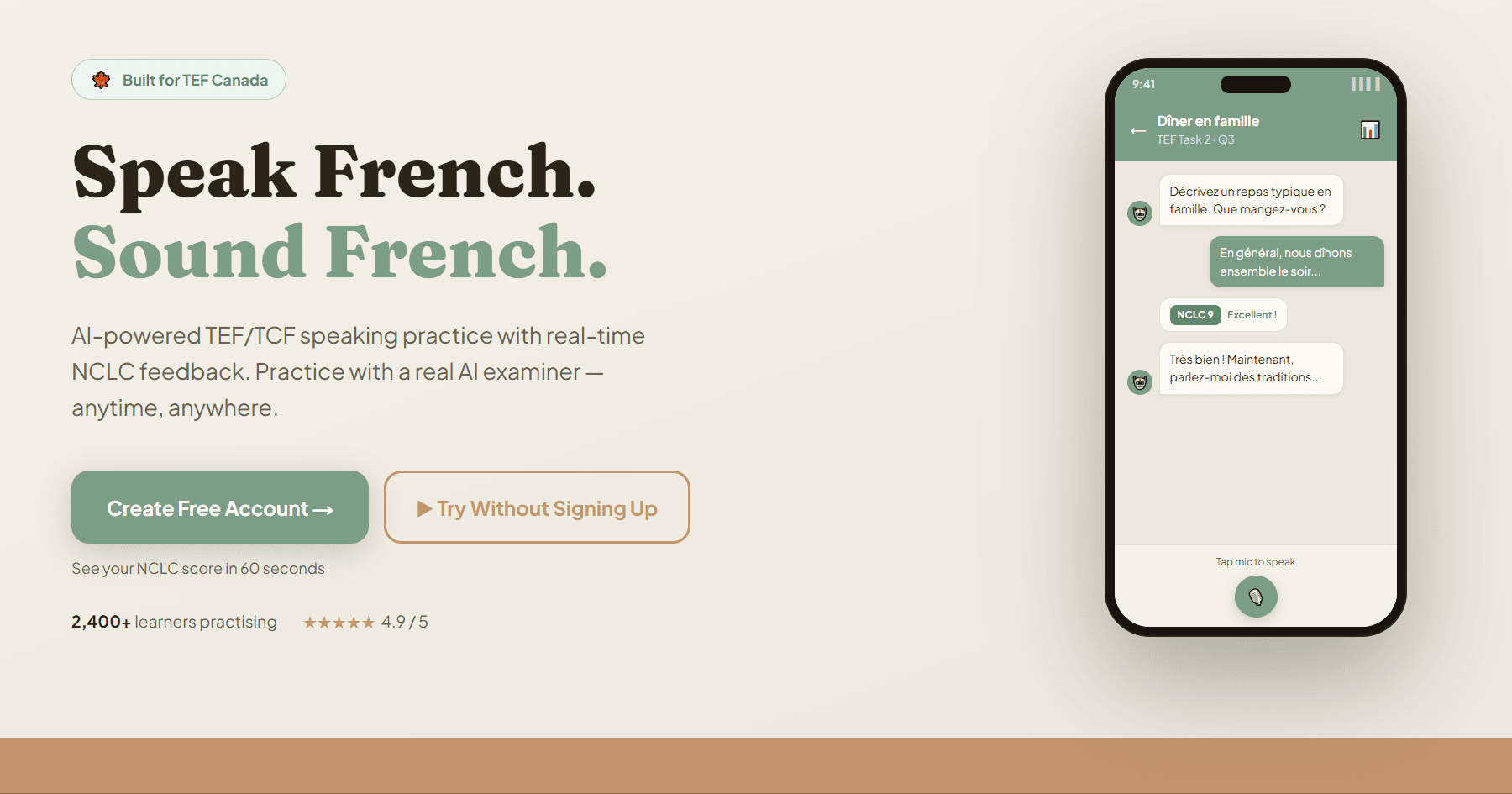
Reading about the tasks only gets you so far. On FrenchShadow you can practise any of these topics out loud: the AI examiner asks the questions or raises the objections, then scores your answer on the NCLC scale. Try a free session, no signup.
Every scenario mentioned here is available to rehearse in the TEF Canada speaking topics library — browse Task 1 and Task 2 scenarios by theme and practise each one out loud with an AI examiner.